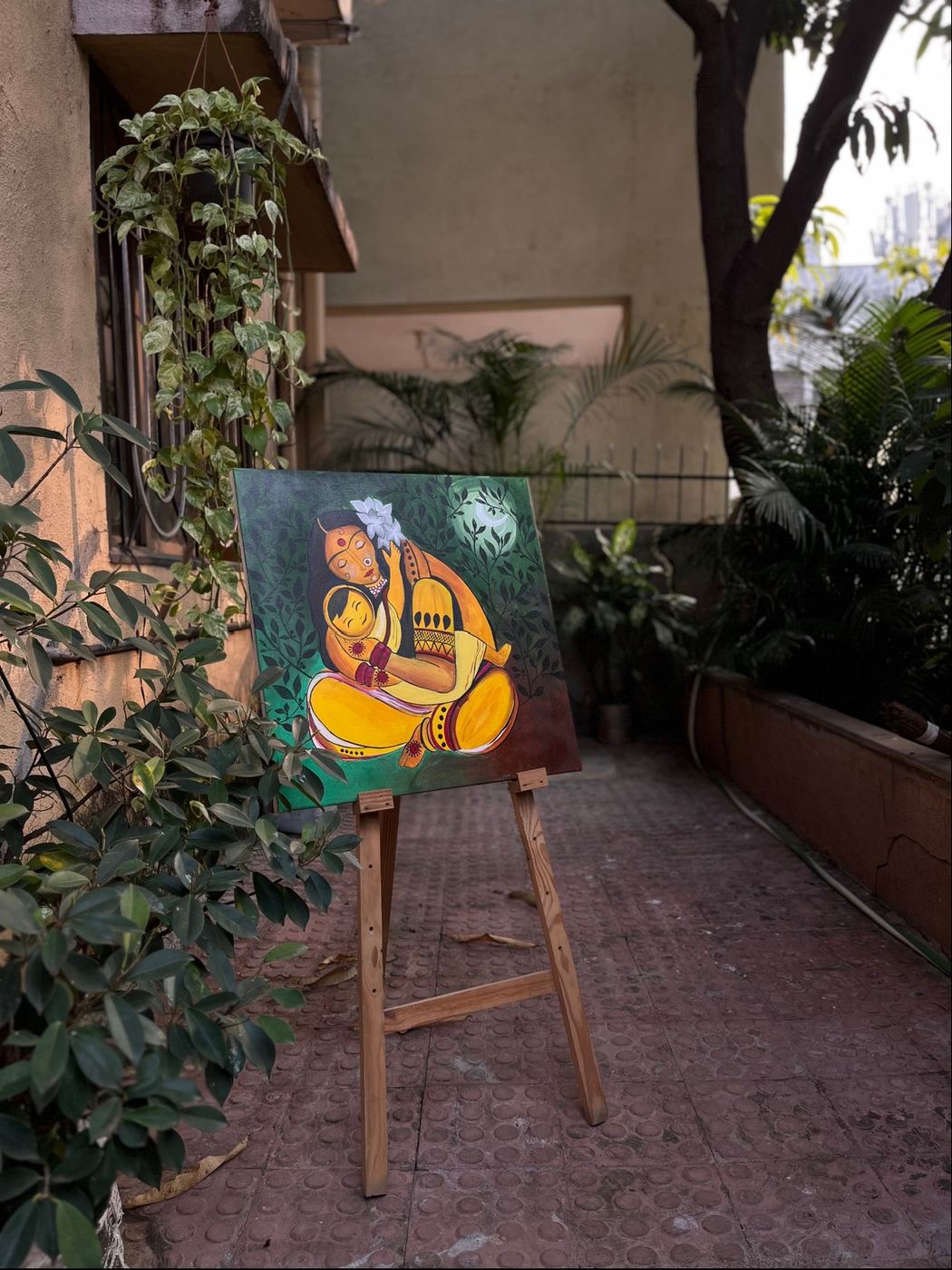
Every painting I make gets photographed before it leaves the studio. Good light, a clean wall, the colours corrected as close to true as a screen allows. And every single time, someone who later sees the piece in person tells me the same thing, in different words: it's not what I expected. Not worse. Not even really better. Just different — in a way that's hard to explain until you've stood in front of it.
What a photo cannot hold
A screen can show you hue and composition. What it cannot show you is scale in your own body — the way a 36-inch canvas changes the way you stand, or how a small piece asks you to lean in rather than step back. It cannot show you texture: the ridge where a palette knife dragged through wet paint, the slight shine where gold leaf catches light differently as you move past it. And it cannot show you the quiet — that particular stillness a room takes on around a painting that a photograph simply has no way to carry.
Because a screen can show you the colours, but never quite the silence around a painting.
Colour behaves differently on a wall
Screens standardise colour in a way real light never does. A rose pink that looks flat in a product photo can turn warm and almost alive under afternoon sun, then cool and moody by evening lamp light. I've had collectors write to me confused about a colour shift between the photo and the piece on their wall — and the answer is almost always simply: light. Paintings are not fixed the way a photograph is. They keep responding to the room they live in, all day, every day.
The part that surprised me most
I didn't expect how much people's posture changes in front of an original. Online, people scroll. In a room, people slow down — they step closer, then back, then closer again, almost involuntarily, the way you'd move around a person rather than a picture. That instinct, I think, is the whole difference. A photograph is something you look at. A painting, in the room with you, is something you're momentarily inside of.
Why I still photograph everything
None of this means the photos are pointless — they're often the only way a piece finds someone who'll never make it to the studio. But I've stopped trying to make a photograph do more than introduce a painting. Its job is to say come closer, not to replace the moment of actually standing there. If a piece ever makes its way to your wall, I hope you get that moment too.
— Rucha
Bought "The Golden Pause" from a photo and was still surprised how the gold leaf shifts through the day — exactly what this describes.
The line about people's posture changing in front of a painting stayed with me. So true and I never noticed it until now.